
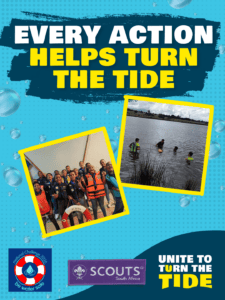
Design: WHO WDP campaign . Photos: Facebook St Croix Sea Scouts & 1st Blairgowrie Scouts
The World Health Organization (WHO) marks World Drowning Prevention Day, reminding governments, organisations and communities that drowning is both predictable and preventable.
The WHO’s campaign highlights that if we unite and promote simple interventions, we can turn the tide on drowning. Actions such as teaching water safety awareness, strengthening community education and equipping young people with practical knowledge can save lives.
SCOUTS South Africa’s “Be Water Safe” National Challenge contributes directly to this global effort by empowering young people not only to keep themselves safe, but also to become ambassadors for water safety within their families, schools and communities.
Being around natural water sources is woven into life in South Africa. Whether paddling a canoe, swimming at the beach, crossing a river on a hike or simply enjoying time around a dam, water creates opportunities for adventure, learning and connection. Yet water also presents one of the greatest preventable risks facing young people.
According to the National Sea Rescue Institute (NSRI), approximately 1,484 people drown in South Africa every year, making drowning one of the country’s leading causes of accidental death. Many of these tragedies could be prevented through greater awareness, practical skills and informed decision-making around water. That is why SCOUTS South Africa has adopted “Be Water Safe” as its 2026 National Challenge; empowering thousands of young people to become more aware, more responsible, and therefore safer around water.
When people think about water safety, they often think about swimming lessons. While learning to swim is important, being water safe involves much more.
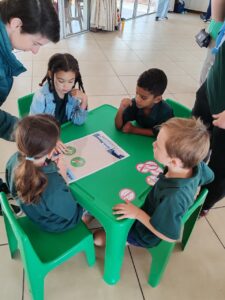
ECS Meerkats
For SCOUTS SA, it’s about teaching young people aged five to thirty to recognise hazards around rivers, dams, beaches and swimming pools, understand how changing weather and floods can increase danger, know how to respond in an emergency, and importantly, know when not to enter the water. Through games, practical activities, emergency scenarios and community engagement, thousands of Scouts across South Africa are developing the confidence to make informed decisions around water and encourage others to do the same.
The National Challenge equips them with practical knowledge and confidence through three simple principles: awareness, preparedness, and service & responsibility. These are not only Scouting skills. They are life skills.
Adventure has always been one of Scouting’s greatest classrooms. Whether hiking through nature reserves, paddling rivers, camping beside dams or exploring South Africa’s coastline, Scouts regularly experience the outdoors in ways that help them understand both its beauty and its risks. The National Challenge uses these experiences to teach young people how to make responsible decisions, assess risks before acting, work as a team during emergencies and care for one another. At the heart of it, it is about ensuring that every adventure ends safely, every lesson builds confidence, and every young person returns home equipped with skills that could one day save a life. This is how SCOUTS SA is building a generation of water-smart youth.
 SCOUTS South Africa’s National Challenge is supported by the Jaryd Payne Foundation and encourages Scout Groups to partner with local stations of the National Sea Rescue Institute (NSRI), combining Scouting’s proven youth development programme with expert water safety knowledge.
WHO calls on us to unite to reduce drowning by 35% by 2035. Closing the gap depends on all of us doing our part – every person, in every place, in every context. This is how SCOUTS South Africa is doing its part and uniting to turn the tide.